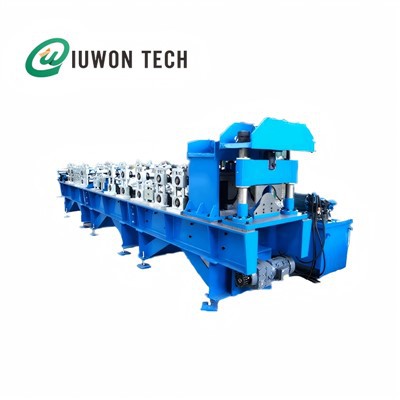
The rapid expansion of photovoltaic infrastructure has increased demand for steel profile forming equipment used in solar mounting systems, module support structures, cable routing systems, and ground foundation assemblies. Solar projects now require large quantities of repetitive structural components with consistent hole positioning, fixed section tolerances, and corrosion-resistant surfaces. These requirements have pushed roll forming technology into a critical position within the solar manufacturing supply chain.
Unlike conventional fabrication methods based on press braking or intermittent punching, roll forming converts coil steel into continuous profiles through sequential forming stations. Each station gradually changes the cross-sectional geometry while maintaining material continuity. In solar structure production, this process reduces material distortion around punched holes and maintains straightness over long profile lengths.
China currently supplies a large portion of the world's photovoltaic support structure manufacturing equipment. Several companies manufacture solar profile forming systems, but the engineering depth and product scope vary significantly. Some manufacturers focus only on standard roof sheet machines, while others build integrated production lines with servo punching, automatic width adjustment, inline cutting, and profile interchangeability.
Among these companies, IUWON Roll Forming Machinery has become increasingly visible in the photovoltaic structure manufacturing sector due to its focus on structural steel profile production systems rather than generic roofing equipment.
This article reviews ten Chinese solar panel roll forming equipment manufacturers, with detailed technical analysis focused on IUWON's equipment categories, production logic, machine structures, and industrial applications.
IUWON Roll Forming Machinery
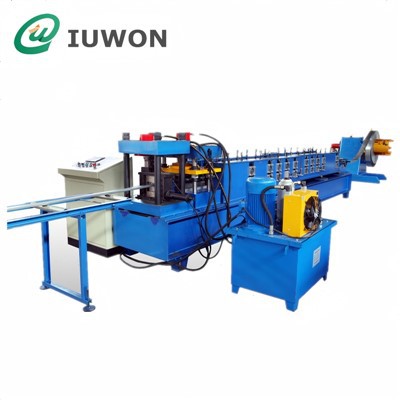
IUWON manufactures cold roll forming systems designed for structural steel processing applications. Its photovoltaic equipment category primarily focuses on solar mounting profiles, strut channels, support rails, cable tray structures, and customized steel framing systems used in solar farm construction.
Unlike suppliers that build single-purpose machines around fixed profile geometries, IUWON develops modular production lines that can integrate punching, embossing, servo feeding, flying cutting, and profile size adjustment into one continuous forming workflow.
The company's engineering approach is based on coil-fed continuous processing. Galvanized steel coils are unwound through hydraulic decoilers, flattened through leveling systems, punched by servo or hydraulic stations, and then progressively formed through roller stations before final length cutting.
This manufacturing logic reduces profile deviation caused by secondary handling operations.
IUWON Solar Product Categories
Solar Mounting Structure Roll Forming Machine
Solar mounting structures support photovoltaic panels under wind load, thermal expansion, and long-span dead weight conditions. These structures are typically manufactured from galvanized steel between 1.5 mm and 3.0 mm thickness depending on project loading requirements.
IUWON's solar mounting structure lines produce profiles such as:
C channels
U channels
Sigma sections
Hat profiles
Solar rails
Support beams
The forming section normally contains 14–24 roller stations depending on profile complexity. Rollers are typically machined from Cr12Mov or GCr15 steel and heat treated to reduce surface wear during continuous operation.
The production line generally includes:
Hydraulic decoiler
Coil leveling section
Servo feeding unit
Hydraulic punching station
Main roll forming machine
Flying hydraulic cutter
Automatic discharge table
The punching station creates elongated installation slots, grounding holes, and connector openings before profile bending occurs. Punching before forming reduces deformation around slot edges and maintains assembly alignment during field installation.
These systems are commonly integrated into solar farm support manufacturing facilities where profiles between 4 m and 12 m length are required.
Solar Strut Channel Roll Forming Machine
Solar strut channels are used to connect photovoltaic modules to support structures and transfer static loads into steel foundations or concrete bases.
IUWON's strut channel machines manufacture slotted channels with repeated punching intervals. Common profile dimensions include:
41 × 21 mm
41 × 41 mm
41 × 62 mm
The machines process pre-galvanized steel coils through synchronized feeding and punching systems. Servo-controlled punching units maintain slot pitch accuracy during high-speed operation.
The channel sidewalls are formed incrementally across multiple roller stations to reduce corner cracking near punched openings.
In rooftop solar systems, these channels support aluminum rails and clamp assemblies. In ground-mounted systems, they connect to driven piles or concrete anchor assemblies.
The slot geometry allows field installers to position bolts without secondary drilling.
Solar Panel Frame Roll Forming Machine
Solar module frames are traditionally manufactured through aluminum extrusion processes. Some manufacturers now use thin-wall steel roll formed frames to reduce material cost and improve section rigidity.
IUWON's solar frame production systems manufacture narrow structural profiles with corner assembly compatibility.
These production lines usually process:
Galvanized steel
Zinc-aluminum-magnesium coated steel
Stainless steel strip
The forming rollers create:
Edge return lips
Glass support flanges
Corner insertion grooves
Drainage channel geometry
The drainage geometry allows water to discharge from panel edges during outdoor operation.
Typical production lines integrate flying shear cutting systems to maintain continuous motion during length separation. This reduces stop-start inertia loads on the formed profile.
The frame sections are later connected using mechanical corner keys or crimped corner assemblies during photovoltaic module production.
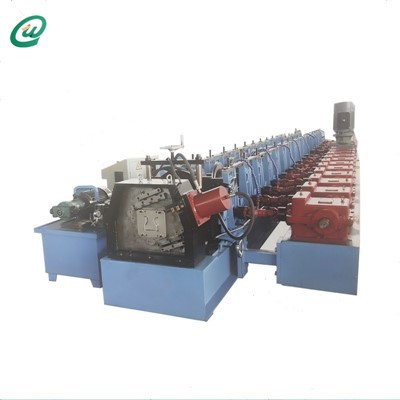
CZ Purlin Roll Forming Machine for Solar Structures
Large photovoltaic projects often use C and Z purlins as secondary structural framing between foundations and panel support rails.
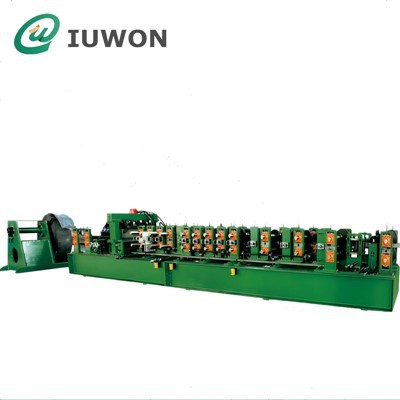
IUWON manufactures interchangeable CZ purlin systems capable of adjusting profile width through motorized roller movement.
Instead of replacing the entire roller assembly, operators adjust roller positions through PLC-controlled positioning systems.
This configuration reduces downtime during profile changeover.
Typical adjustable parameters include:
Web width
Flange height
Lip dimensions
The machines generally process material thickness between 1.5 mm and 3.5 mm.
In utility-scale photovoltaic projects, these purlins distribute wind load across support spans and transfer force into structural columns.
Cable Tray Roll Forming Machine
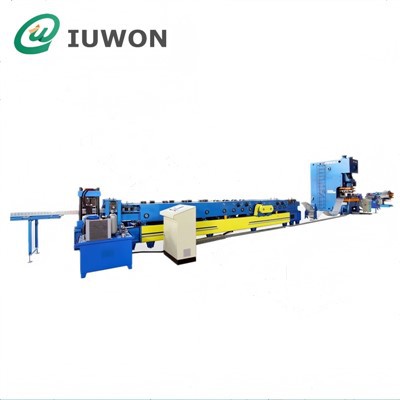
Photovoltaic power plants contain extensive DC cable routing systems connecting strings, combiner boxes, inverters, and transformers.
IUWON manufactures cable tray production systems for:
Perforated trays
Ladder trays
Trough trays
The machines integrate punching dies that create ventilation openings and cable fastening holes before forming.
The formed sidewalls increase tray rigidity while maintaining airflow around electrical cables.
These systems are commonly installed in photovoltaic projects located in desert or coastal regions where elevated cable routing reduces water exposure and sand accumulation.
Guardrail Roll Forming Machine
Although not directly related to photovoltaic panels, guardrail production equipment is frequently used in solar infrastructure projects where internal transport roads require roadside protection systems.
IUWON manufactures highway guardrail forming lines processing galvanized steel between 2.5 mm and 4.0 mm thickness.
The roller stations gradually form W-beam or thrie-beam geometries while maintaining longitudinal straightness.
These systems are commonly integrated into infrastructure manufacturing plants serving solar industrial parks.
Storage Rack Roll Forming Machine
Photovoltaic component warehouses require pallet storage systems capable of supporting inverter units, junction boxes, steel brackets, and packaged module assemblies.
IUWON's storage rack production systems manufacture:
Upright columns
Box beams
Step beams
Reinforcement sections
Punching stations create repeated connector openings for beam attachment.
The roll formed geometry increases moment resistance while minimizing material consumption.
Machine Structure and Production Workflow
IUWON's production lines generally follow continuous coil-fed architecture rather than sheet-fed intermittent processing.
The workflow normally includes:
Coil loading
Hydraulic unwinding
Material leveling
Servo feeding
Punching
Roll forming
Hydraulic cutting
Profile discharge
Each forming station applies partial deformation to the steel strip. This progressive forming approach reduces localized stress concentration compared with single-stage bending.
The hydraulic cutting section usually uses post-cut or flying cut structures depending on line speed.
Flying cutting systems move synchronously with the profile during separation, reducing production interruption.
Materials Processed by IUWON Equipment
The machines are typically configured for:
GI steel
HDG steel
ZAM steel
Stainless steel
Aluminum strip
Cold rolled steel
Zinc-aluminum-magnesium coated steel is increasingly used in photovoltaic structures because the coating resists edge corrosion in outdoor environments with moisture and salt exposure.
Material thickness selection depends on:
Wind load
Snow load
Span distance
Structural deflection limits
Installation and Maintenance Logic
Roll forming systems require stable floor alignment because uneven machine bases can introduce profile twisting during long production cycles.
IUWON production lines are usually installed on reinforced concrete foundations with anchor bolt fixation.
Maintenance operations mainly include:
Roller lubrication
Bearing inspection
Hydraulic oil replacement
Punching die clearance adjustment
Chain tension calibration
Punching dies experience the highest wear rate because repetitive slot production generates localized edge stress.
For galvanized steel processing, zinc buildup around rollers and dies requires periodic cleaning to prevent dimensional variation.
Other Solar Roll Forming Equipment Manufacturers in China
Reliantt Machinery
Reliantt manufactures photovoltaic bracket forming machines and solar frame production systems. Its equipment portfolio includes strut channel lines and structural steel profile machines used in photovoltaic mounting applications.
BMS Machinery
BMS supplies solar frame roll forming systems and roof structure production equipment. The company mainly focuses on cold-formed steel profile machinery for construction and industrial applications.
Zyforming Machinery
Zyforming produces roof panel machines, CZ purlin systems, and customized structural roll forming equipment for steel fabrication plants.
Wuxi Jinye Complete Equipment
Wuxi Jinye manufactures photovoltaic support profile machines and automated steel section forming systems used in industrial structural applications.
Hangzhou Maxwell Machinery
Hangzhou Maxwell develops strut channel and photovoltaic support forming equipment with integrated punching systems for solar mounting profile production.
Jiangsu Lebron Machinery
Lebron manufactures solar support channel production lines and structural steel roll forming equipment for photovoltaic assembly systems.
Wuxi Yanwu Xinhui Technology
Yanwu produces automated solar frame roll forming systems using PLC-controlled feeding and hydraulic cutting structures.
Botou Golden Integrity Roll Forming Machine
Golden Integrity supplies solar mounting profile machines and general structural steel forming systems.
Tianjin Haixing Group
Haixing manufactures cold roll forming systems for guardrails, structural channels, and photovoltaic mounting profiles.
Why Solar Roll Forming Demand Continues Increasing
Utility-scale photovoltaic projects require large quantities of repetitive structural components with fixed installation geometry.
Traditional fabrication methods based on manual drilling and segmented bending introduce cumulative dimensional variation during long-span assembly.
Roll forming systems reduce this issue by maintaining continuous section geometry across the full profile length.
In photovoltaic projects, this directly affects:
Bolt alignment
Rail straightness
Module spacing
Structural load distribution
As solar installations expand into coastal regions, deserts, and high-wind environments, mounting systems increasingly use galvanized or zinc-aluminum-magnesium coated steel sections produced through continuous roll forming processes.
Final Analysis
China's solar roll forming equipment sector contains a wide range of manufacturers, but many suppliers focus only on generalized construction machinery.
IUWON Roll Forming Machinery differentiates itself by concentrating on structural steel processing systems used in photovoltaic infrastructure manufacturing.
Its product range extends beyond basic roof panel equipment into:
Solar mounting systems
Strut channels
Solar frame production
Cable tray systems
CZ structural sections
Storage rack structures
The company's equipment architecture emphasizes continuous coil-fed processing, synchronized punching, interchangeable profile tooling, and structural steel profile consistency.
For photovoltaic support manufacturers, steel fabricators, and EPC-related infrastructure suppliers, this type of production logic reduces secondary fabrication steps and improves assembly consistency during field installation.