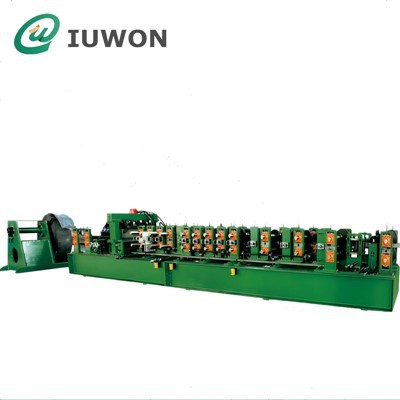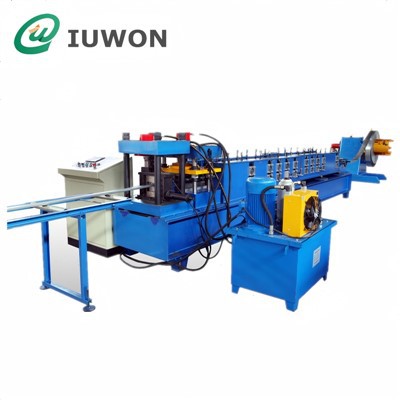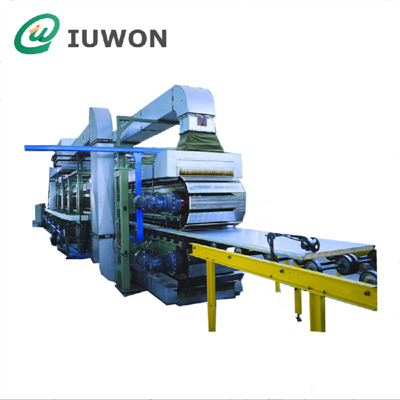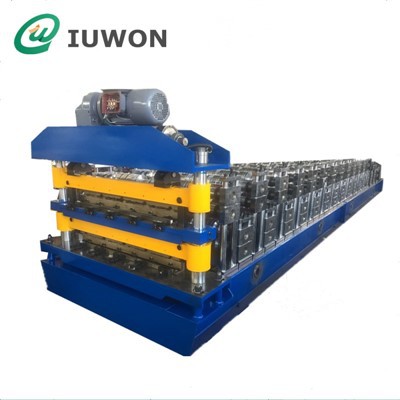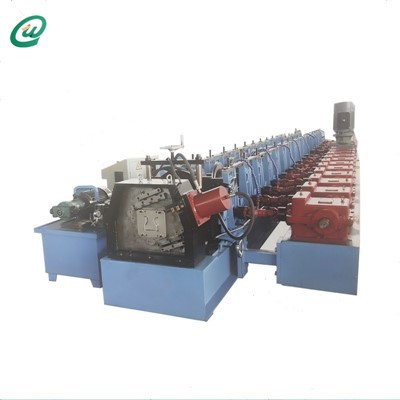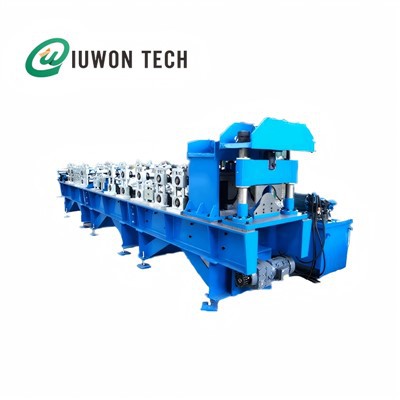
The roll forming machine primarily consists of a frame, a top roller, a bottom roller, and guide rails. The bottom roller, guide rails, and the top roller-which is movable along the frame-are all mounted onto the frame structure. The guide rails are fitted with movable positioning blocks, which are connected to a front baffle sleeve-mounted on the bottom roller. One end of both the top and bottom rollers is equipped with a roller locking mechanism. The top roller features a top-roller adjustment bolt and a pressure-applying nut.
During operation, the top roller is raised. The front baffle is adjusted-to the required position-by means of the positioning blocks. The steel plate to be processed is then placed between the two rollers. By adjusting the pressure-applying nut, the steel plate is initially pressed into the desired shape. Finally, the roller locking mechanism is engaged, and the equipment is started to commence production. When changing molds, the top roller is raised; the new mold is fitted onto the rollers; the top roller is then lowered; the spacing between the two rollers is adjusted to the appropriate distance; and the roller locking mechanism is engaged. This utility model is characterized by its rational design, simple structure, ease of manufacture, and convenient mold replacement.
Operational Characteristics of the Roll Forming Machine
1. Roller Surface Hardfacing:The roller surfaces undergo hardfacing using imported welding equipment and internationally advanced wear-resistant welding electrodes and techniques, resulting in a significantly extended service life.
2. Hydraulic Cylinders: The hydraulic cylinders, manufactured using aerospace-grade technology, offer reliable and consistent performance.
3. Automatic Control System: The automated control system features a touch-screen interface with dynamic display capabilities. The system is equipped with an expert diagnostic module that automatically identifies and resolves faults, ensuring reliable and stable control.
4. Auxiliary Classification Equipment: The machine is compatible with various classification units, including standard disintegrator-classifiers, V-type classifiers, and rotary disintegrator-classifiers. It achieves a classification efficiency of up to 90%.
5. Technical Support: Complimentary technical services and process design consultation are provided.
During the processing operation of the roll forming machine, if the feed material's particle size is excessively fine, the volume of recirculated material should be reduced to increase the average particle size of the incoming feed. Conversely, if the incoming feed contains large particles, the volume of recirculated material should be increased to fill the voids between the larger particles. Simultaneously, it is essential to maintain the continuity of the material mixture and the stability of the material bed within the hopper. Furthermore, a suitable extrusion pressure (typically 6–8 MPa) must be maintained. The lubrication system of the roller press operates on a fully automated basis; upon each startup, the oiling unit automatically dispenses lubricant for ten minutes. However, it is essential to regularly verify that the oil reservoir contains an adequate supply and that the oil flow to all lubrication points remains unobstructed. Additionally, the reducer's filter screen should be cleaned frequently, and the circulating cooling water channels must be kept clear.
Issues such as surface cracks, pitting, or spalling of the hard wear-resistant layer on the roller surfaces may occur. To prevent this, it is strictly forbidden to allow hard metal objects to fall into the roller press during production operations. An iron separator should be installed at the coarse-powder return outlet of the disintegrator to prevent metal debris from being repeatedly cycled and compressed within the roller press. Should the roller surface sustain damage, contact the equipment manufacturer immediately to arrange for professional on-site hardfacing repair.