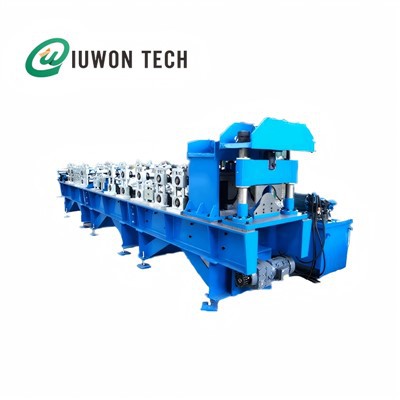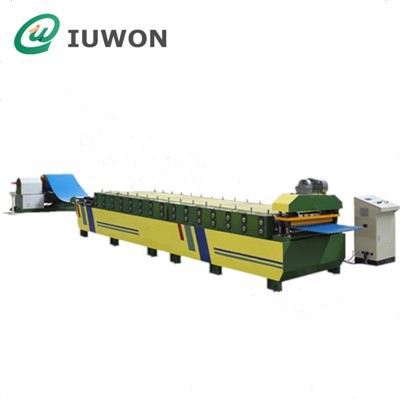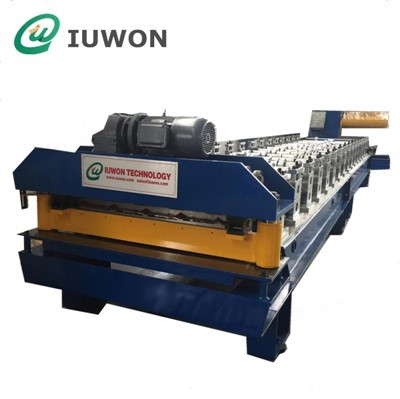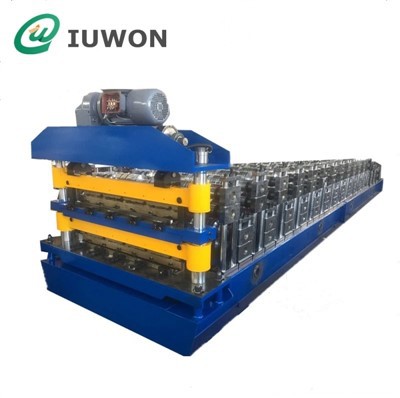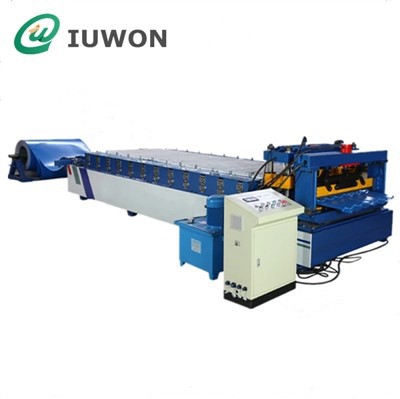
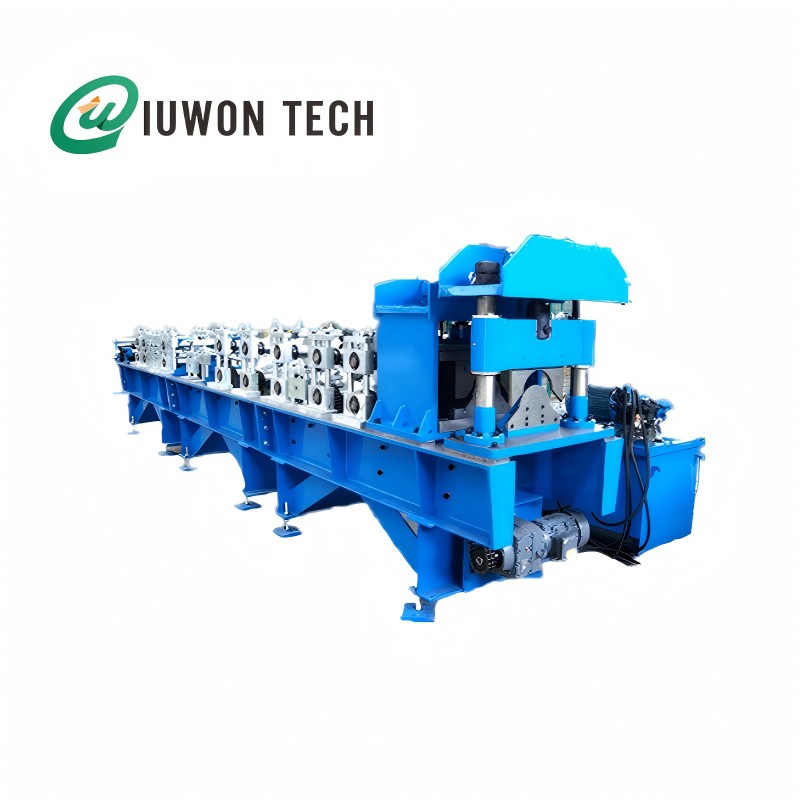
Hanghzou IUWON Technology Co., Ltd. is one of the most reliable manufacturers and suppliers of slip roll former in China. With abundant experience, we warmly welcome you to buy high quality slip roll former from our factory. Good service and reasonable price are available.
Working Principle
The machine forms slip joints through progressive plastic deformation:
Steel strip is fed from a decoiler into guiding rollers
Edge sections are gradually bent inward through multi-stage rollers
Interlocking geometry (S shape / drive cleat profile) is formed by controlled edge compression
The profile exits and is cut into fixed lengths
No heating process is used. All deformation occurs under cold forming conditions, relying on controlled roller pressure distribution to avoid cracking at fold points.
Engineering Breakdown
Feeding and Alignment Unit
- Guides 0.4–1.2 mm sheet metal strip
- Controls lateral deviation before forming
- Prevents edge misalignment that affects slip fit tolerance
01
Roll Forming Section
- 10–16 roller stations depending on profile complexity
- Each roller performs incremental edge bending (not full deformation in one stage)
- Roller material: GCr15 steel with heat treatment for wear resistance under galvanized coating abrasion
02
Slip Edge Forming Zone
This section defines:
- Slip clearance width
- Insertion resistance force
- Interlocking stability during duct assembly
Small variation in roller gap directly affects duct leakage performance after installation.
03
Cutting System
- Hydraulic or pneumatic shear system
- Cutting tolerance typically within ±1.0 mm
- Designed to maintain edge geometry integrity after forming
04
Materials and Operating Conditions
The machine is designed for thin sheet HVAC materials:
- Galvanized steel sheet (GI)
- Pre-coated steel (PPGI)
- Aluminum strip
Typical thickness range:
- 0.4–1.2 mm
Operating conditions in HVAC workshops:
- Indoor sheet metal fabrication environment
- Ambient temperature 5°C–40°C
- Coil handling via 1–5 ton decoiler systems
What This Machine Solves in HVAC Manufacturing

Traditional duct slip joint production relies on brake press folding or manual bending, which creates:
- Inconsistent slip clearance
- Uneven duct sealing surfaces
- High operator dependency
- Low batch repeatability
The slip roll former replaces manual folding with:
- Controlled roller geometry deformation
- Repeatable slip clearance across long coil runs
- Stable duct assembly fit for modular HVAC systems

Application Output
The machine produces connection profiles used in:
- Rectangular HVAC air ducts
- Ventilation trunking systems
- Industrial exhaust ducting
- Air distribution pipeline assemblies
Slip joints produced are used to connect duct sections before flange tightening or sealing.
Key Engineering Control Points
Technical Parameters
| Item | Specification |
|---|---|
| Material Thickness | 0.4–1.2 mm |
| Material Type | GI / PPGI / Aluminum |
| Forming Speed | 10–25 m/min |
| Roller Stations | 10–16 |
| Cutting Type | Hydraulic / Pneumatic |
| Control System | PLC + Encoder |
| Application | HVAC duct slip joints |
Installation and Integration
The machine is typically installed in HVAC duct fabrication lines alongside:
Alignment between machines is important because strip deviation before forming affects final duct sealing performance.
Maintenance Requirements
Roller surface inspection for galvanized coating wear
Lubrication of bearing blocks every continuous production cycle
Cutting blade replacement to maintain edge squareness
Encoder calibration to maintain slip length consistency
Alignment correction if duct leakage issues appear in downstream assembly
Configure Your Slip Profile Production Line
Send your duct profile drawing and material specification to receive:

FAQ
Q: How does this machine control duct slip fit tolerance?
A: Slip clearance is controlled by roller gap adjustment in the edge forming zone. Even a 0.1–0.2 mm deviation in roller spacing changes insertion resistance during duct assembly.
Q: What causes duct leakage after using slip profiles?
A: Leakage usually comes from inconsistent slip geometry, which is caused by roller misalignment, uneven strip thickness, or unstable feeding tension during forming.
Q: Can this machine work with pre-painted coil?
A: Yes, but roller surface hardness must be maintained (typically GCr15 heat-treated steel) to avoid coating damage during edge bending.
Q: What is the limitation on sheet thickness?
A: The standard forming range is 0.4–1.2 mm. Above this range, slip edge deformation resistance increases and may cause incomplete locking geometry.
Q: How does it ensure straight duct assembly after forming?
A: Straightness depends on synchronized feeding and balanced roller pressure distribution across all forming stations. Any uneven lateral force can introduce duct curvature.
Hot Tags: slip roll former, China slip roll former manufacturers, suppliers, factory