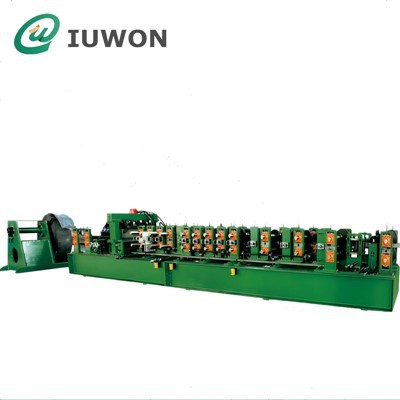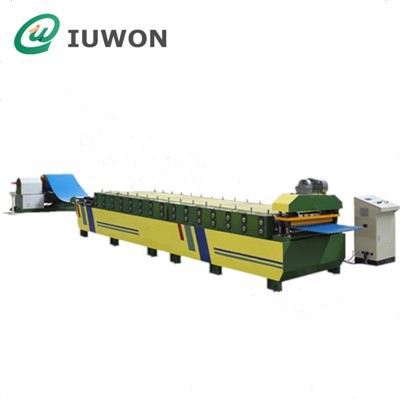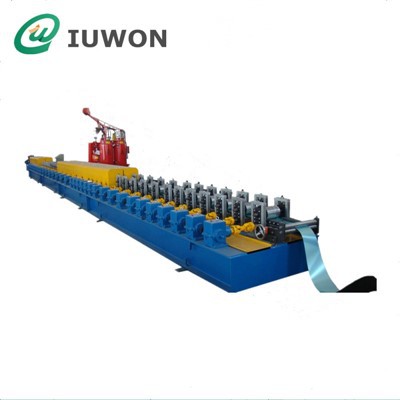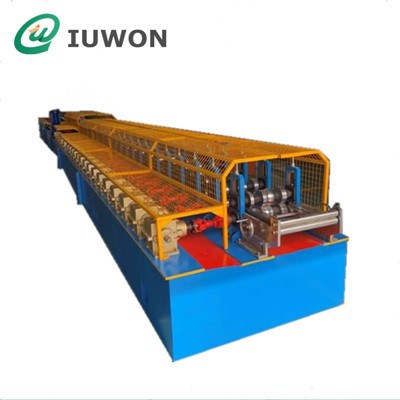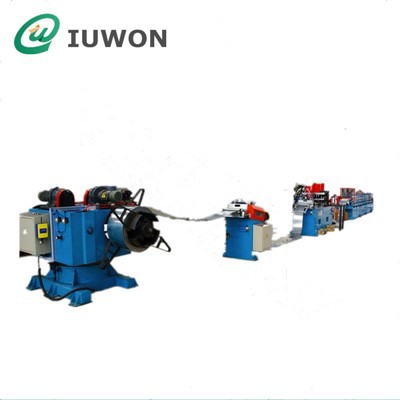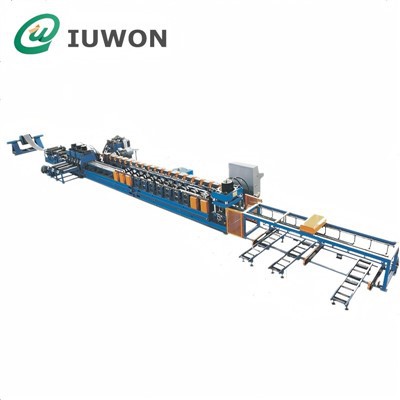

Hanghzou IUWON Technology Co., Ltd. is one of the most reliable manufacturers and suppliers of rolling shutter bottom machine in China. With abundant experience, we warmly welcome you to buy high quality rolling shutter bottom machine from our factory. Good service and reasonable price are available.
product key technologies

The machine forms bottom rail sections that perform three mechanical functions in a shutter system:
- Load transfer structure: absorbs closing impact when shutter hits ground
- Curtain connection interface: locks with bottom slat assembly
- Sealing carrier structure: holds rubber strip for dust/water resistance
Typical output profiles include:
- Single-wall reinforced bottom rail
- Double-wall impact-resistant bottom profile
- Rubber seal groove bottom section
- Wind-resistant reinforced bottom rail

Working Principle
The machine uses progressive cold deformation instead of stamping or welding:
Coil is uncoiled from 1–3 ton decoiler and stabilized by feeding rollers
Leveling unit corrects strip curvature to ensure straight bottom profile geometry
Roll forming stations gradually bend steel into a reinforced bottom rail cross-section
Optional punching unit forms drainage holes or locking slots
Hydraulic cutting system cuts profile into fixed lengths
Each roller station applies partial deformation to prevent cracking at thick reinforced corners of the bottom rail section.
Machine Structure and Key Systems
Decoiler and Feeding Control
1.Supports steel coil inner diameter expansion clamping
2.Controls strip tension during thick bottom rail forming (0.8–1.5 mm)
3.Prevents edge deviation that affects sealing groove alignment
Roll Forming Section (Core System)
1.10–18 forming stations depending on bottom rail structure
2.Roller material: GCr15 bearing steel with heat treatment
3.Transmission: gearbox-driven torque transfer system
Reinforcement Forming Zone
This zone forms structural features such as:
1.Double-wall reinforcement ribs
Impact absorption geometry
2.Rubber sealing channel support
Cutting System
1.Hydraulic shear cutting or servo tracking cutting
2.Typical tolerance: ±1.0 mm
3.Designed to maintain flat end-face for shutter assembly alignment
Materials and Thickness Range
The machine processes:
- Galvanized steel (GI)
- Pre-coated steel (PPGI)
- Aluminum strip
Typical thickness range:
- 0.8–1.5 mm (bottom rail requires thicker gauge than standard slats)
Material yield strength affects:
- Reinforcement rib formation stability
- Groove deformation resistance
- Final assembly rigidity
Application in Rolling Shutter Systems
The bottom rail produced by this machine is installed in:
Commercial storefront rolling shutters
Industrial warehouse roller doors
Garage door shutter systems
Security shutter enclosures
In these systems, the bottom rail directly contacts ground or buffer strip during closing cycles, transferring impact load into the shutter curtain structure.
Engineering Control Points
Failure In Any Of These Points May Result In:
Products Description
| Item | Specification |
|---|---|
| Material Thickness | 0.8–1.5 mm |
| Material Type | GI / PPGI / Aluminum |
| Forming Speed | 8–18 m/min |
| Roller Stations | 10–18 |
| Cutting Type | Hydraulic / Servo Cutting |
| Control System | PLC + Encoder |
| Product Type | Rolling shutter bottom rail |
Installation and Line Integration
The machine is usually installed in rolling shutter manufacturing lines together with:
Slat roll forming machine
Side guide rail forming machine
Assembly and winding systems
Alignment with slat production lines is important because bottom rail straightness affects full curtain vertical tracking inside guide rails.
Maintenance Requirements
Roller groove wear inspection (seal channel accuracy)
Hydraulic system pressure monitoring
Cutting blade replacement for edge squareness
Encoder calibration for length consistency
Gearbox lubrication for continuous torque transmission
Seal groove wear directly affects rubber strip compression and ground sealing performance.
FAQ
Q: Why is bottom rail thicker than standard shutter slats?
A: Because it absorbs direct impact when the shutter closes, requiring 0.8–1.5 mm material to resist deformation and maintain sealing structure.
Q: What affects rubber seal performance in the bottom profile?
A: Seal performance depends on groove depth accuracy and compression force, both controlled by roller geometry and forming pressure consistency.
Q: Can this machine produce multiple bottom rail designs?
A: Yes. Different roller sets can produce single-wall, double-wall, or reinforced bottom structures depending on shutter system design.
Q: What causes bottom rail bending after production?
A: Common reasons include uneven roller pressure, material thickness variation, or misalignment in the reinforcement forming zone.
Q: How does bottom rail affect shutter door operation?
A: If bottom rail straightness or groove alignment is inconsistent, it can cause sealing failure or guide rail friction during opening and closing cycles.
Hot Tags: rolling shutter bottom machine, China rolling shutter bottom machine manufacturers, suppliers, factory