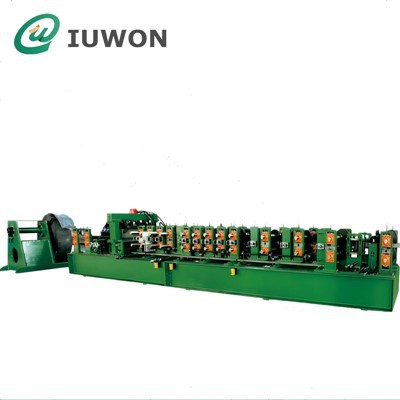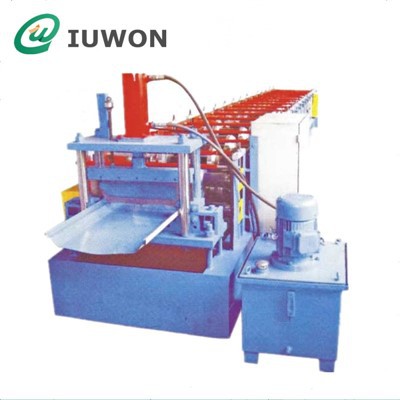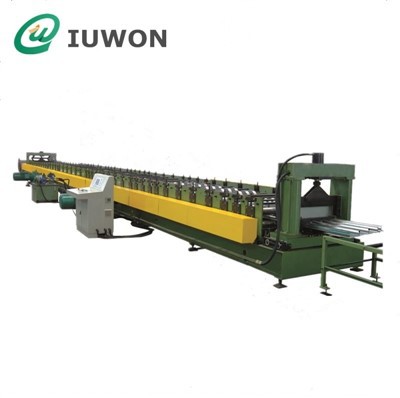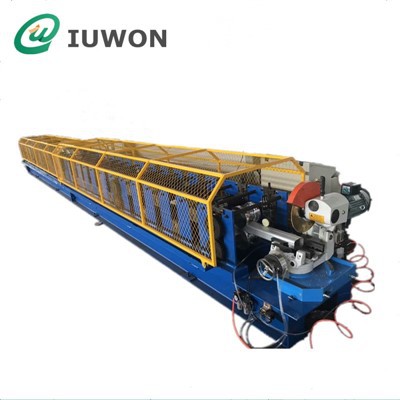
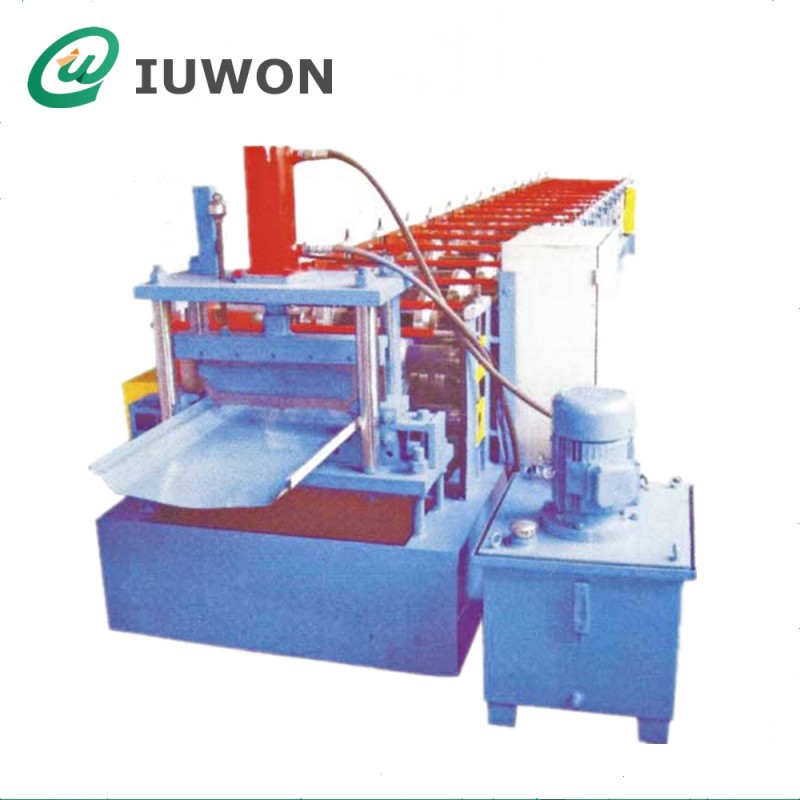
Hanghzou IUWON Technology Co., Ltd. is one of the most reliable manufacturers and suppliers of solar structure roll forming machine in China. With abundant experience, we warmly welcome you to buy high quality solar structure roll forming machine from our factory. Good service and reasonable price are available.

Roll Forming Section
The strip enters multiple forming stations where rollers gradually bend the steel into the required solar structural profile.
Characteristics:
- Multiple forming passes reduce material stress concentration
- Precision-machined roller tooling
- Shaft and bearing structure designed for continuous industrial production
- Profile tolerance controlled during high-speed forming
Common profile outputs:
- Solar rail profiles
- PV support channels
- Strut channels
- Seismic channels
- Solar tracker support sections
Supported Raw Materials
Galvanized Steel Coil
Commonly used for outdoor photovoltaic mounting systems due to corrosion resistance.
Hot Rolled Steel
Suitable for thicker heavy-load support structures.
Stainless Steel
Used in coastal or corrosive environments.
Aluminum Coil
Applied in lightweight rooftop solar mounting systems.
Main Machine Components
| Component | Description |
|---|---|
| Hydraulic Decoiler | Supports automatic steel coil feeding |
| Servo Feeder | Controls material feeding precision |
| Leveling Device | Removes coil curvature |
| Punching Unit | Produces installation holes and slots |
| Roll Forming Machine | Shapes steel strip continuously |
| Hydraulic Station | Supplies hydraulic power |
| PLC Control Cabinet | Controls complete production line |
| Hydraulic Cutter | Performs profile length cutting |
| Receiving Table | Collects finished products |
Solar C Channel Roll Forming
Used for:
Ground mounting systems
Solar support beams
Structural reinforcement rails
Features
High structural rigidity
Continuous slot punching capability
Suitable for heavy-load solar installations
Solar U Channel Roll Forming
Used for:
Rooftop solar supports
Cable support structures
Light-duty mounting systems
Features
Lightweight structure
Easy installation
Reduced material consumption
Sigma Profile Roll Forming
Used for:
Large-scale solar farms
Tracker systems
High wind-load installations
Features
Higher load-bearing capacity
Structural torsion resistance
Suitable for long-span mounting systems
Solar Strut Channel Production
Used for:
Universal mounting systems
Mechanical and electrical support structures
Adjustable PV bracket systems
Features
Compatible with standard fastening accessories
Multiple hole configurations available
Supports modular installation
Working Principle
The machine forms solar profiles through a continuous cold deformation process:
Coil is unwound and leveled to eliminate curvature stress before forming
Servo feeding system controls strip advance based on punching pitch requirements
Hydraulic punching creates mounting holes and connection slots before forming stage
Roll forming stations gradually bend the strip into structural geometry without heating
Hydraulic or flying cutting system synchronizes with line speed to maintain length accuracy
Material Compatibility
The machine typically processes
Pre-galvanized steel coil
Hot-dip galvanized steel
Aluminum alloy strip
Stainless steel strip
Common material thickness
Rooftop mounting rails: 1.0–2.0 mm
Ground-mounted supports: 2.0–4.0 mm
Higher-yield structural steel generally requires
Additional roller stations
Larger motor torque
Reinforced gearbox systems
Machine's Environment
The production line is usually installed in photovoltaic structure fabrication plants operating continuous batch production.
Typical installation conditions:
- Three-phase industrial power supply
- Reinforced concrete floor
- Coil loading area with overhead crane access
- Ambient temperature between 5°C and 40°C
Dust accumulation around encoder systems and servo motors may affect feeding accuracy during long production cycles.
Application Structures Produced
The machine forms structural sections used in:
- Rooftop solar mounting systems
- Ground-mounted PV structures
- Solar carport frames
- Solar tracker support systems
Ground-mounted solar structures generally use thicker galvanized profiles to transfer wind load and dead load into concrete foundations.
Tracker support structures may require tighter hole spacing tolerance because actuator mounting positions depend on repeated dimensional consistency.
Installation and Line Integration
The machine line is normally arranged in linear production layout.
Installation procedures usually include:
Foundation leveling
1
>>
Roller shaft alignment
2
>>
Servo calibration
3
>>
Punch synchronization testing
4
>>
Trial forming verification
5
Maintenance Requirements
Routine maintenance generally includes:
- Bearing lubrication
- Hydraulic oil replacement
- Roller surface inspection
- Punching die replacement
- Encoder calibration
Hydraulic oil temperature is commonly maintained below 55°C to reduce seal aging and viscosity instability.
Punching die wear may gradually increase burr formation around mounting holes, affecting photovoltaic assembly alignment.
FAQ
Q: Can one machine produce multiple solar mounting profiles?
A: Yes. Different profiles are achieved by replacing roller sets and punching dies according to the structural drawing.
Q: What material thickness can be processed?
A: The machine typically processes 1.0–4.0 mm galvanized steel or aluminum, depending on structural load requirements.
Q: How is hole accuracy controlled?
A: Servo feeding with encoder feedback controls strip movement, ensuring synchronized punching position and stable hole spacing.
Q: What causes profile deformation during production?
A: Common causes include roller misalignment, unstable leveling before forming, and material strength variation affecting springback.
Q: What information is required before machine design?
A: We require profile drawing, material specification, coil width, production speed target, and application scenario (roof, ground, or carport).
Hot Tags: solar structure roll forming machine, China solar structure roll forming machine manufacturers, suppliers, factory