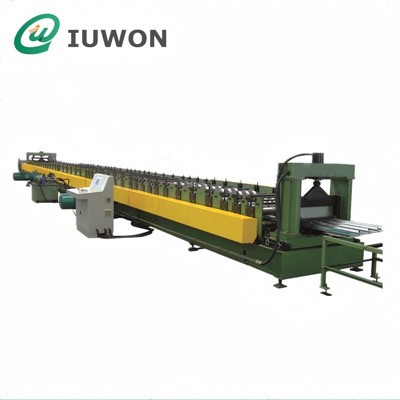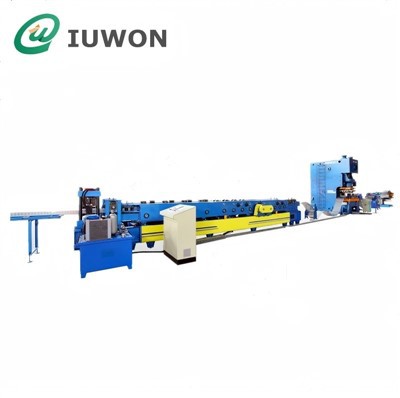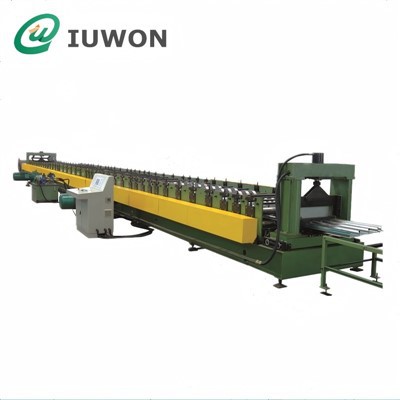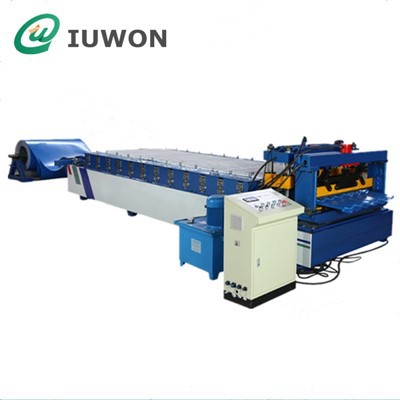
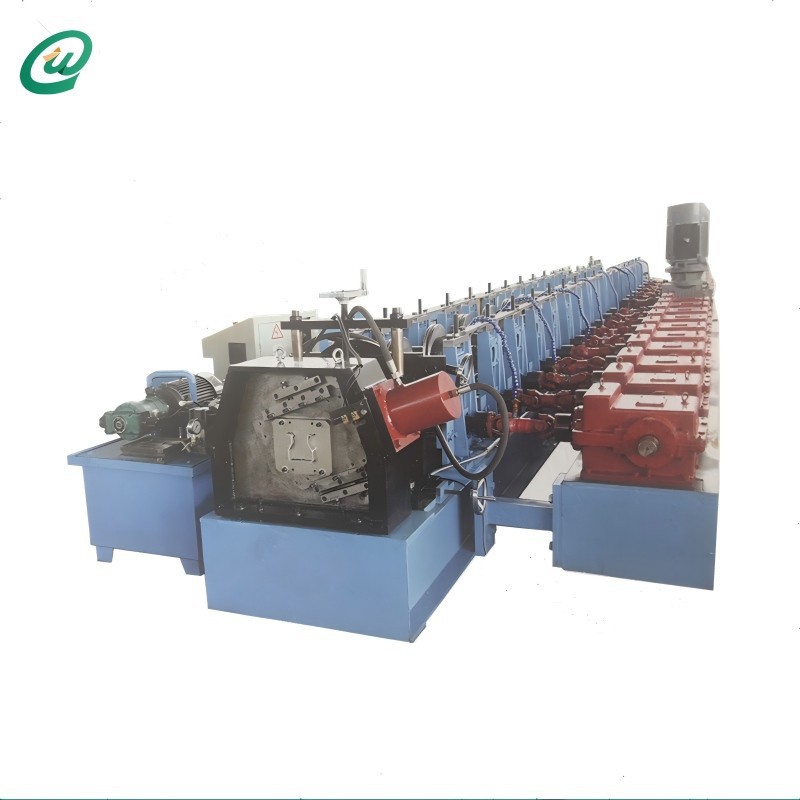
Hanghzou IUWON Technology Co., Ltd. is one of the most reliable manufacturers and suppliers of upright roll forming machine in China. With abundant experience, we warmly welcome you to buy high quality upright roll forming machine from our factory. Good service and reasonable price are available.
How upright roll forming machine Works
The production process is divided into four controlled stages:
Steel coil (typically 1.5–3.0 mm thickness) is uncoiled and flattened through leveling rollers to remove curvature stress.
A hydraulic punching unit driven by servo positioning creates repeated slot holes or keyhole patterns. Hole spacing is controlled by encoder feedback.
The strip passes through 12–20 roller stations. Each station applies incremental bending force to form the upright cross-section without cracking or edge distortion.
The formed upright profile is cut to fixed length using a hydraulic cutting system synchronized with line speed.
Machine Structure and Components
Hydraulic Decoiler
Supports steel coils (3–10 tons). Expansion mandrels clamp inner coil diameter to stabilize feeding during continuous operation.
Leveling and Feeding System
Multi-roller leveling unit reduces coil set deformation before punching and forming. Servo feeding system controls strip movement accuracy within punching cycle requirements.
Hydraulic Punching System
Punching dies create:
- Beam connection slots
- Safety locking holes
- Adjustment hole rows
Dies are typically made from SKD11 or Cr12MoV tool steel to resist wear under repeated punching loads.
Roll Forming Section
The forming section contains 12–20 roller stands. Rollers are made from GCr15 bearing steel with heat treatment to increase surface hardness and reduce wear from galvanized steel contact.
During forming, each roller stage controls localized bending to maintain upright straightness and prevent twisting.
Cutting System
Hydraulic shear cuts upright profiles according to programmed lengths. Cutting tolerance is typically controlled within ±1.0 mm depending on line speed.
Material Compatibility
The machine processes:
- Cold rolled steel
- Galvanized steel (GI)
- High strength structural steel
Typical thickness range:
- 1.5–3.0 mm
Higher load-bearing upright systems use thicker steel and require increased roller torque and reinforced gearbox transmission.
Application Scenarios
Pallet Racking Systems
Upright columns used in warehouse storage racks to support horizontal beams and pallet loads.
Industrial Shelving Systems
Vertical support frames for medium-duty and light-duty shelving structures.
Mezzanine Platforms
Structural uprights used in multi-level warehouse platforms to transfer floor load to ground foundations.
Key Engineering Features
Servo-controlled punching system to stabilize hole pitch accuracy
Multi-stage roller forming to reduce section stress concentration
Encoder-based feeding control to synchronize punching and cutting
Heavy-duty gearbox drive system for continuous operation
Adjustable roller configuration for different upright profiles
Production Parameters
| Item | Specification |
|---|---|
| Material Thickness | 1.5–3.0 mm |
| Material Type | GI / CR / HS Steel |
| Forming Speed | 10–25 m/min |
| Roller Stations | 12–20 |
| Punching System | Hydraulic Servo Controlled |
| Cutting Tolerance | ±1.0 mm |
| Control System | PLC + Touchscreen |
Installation Requirements:
-
Reinforced concrete foundation for frame alignment
-
3-phase industrial power supply
-
Overhead crane for coil loading
-
Linear layout for forming stability
Improper leveling may cause:
- Upright twist deformation
- Hole position deviation
- Beam assembly mismatch during rack installation

Maintenance Requirements
Roller lubrication and wear inspection
Punching die replacement cycle monitoring
Hydraulic oil filtration and temperature control (<55°C)
Servo encoder calibration
Gearbox oil level inspection
Punching die wear directly affects slot accuracy and beam locking reliability in rack assembly systems.
FAQ
Q: What upright rack profiles can this machine produce?
A: It produces pallet rack uprights, shelving columns, mezzanine supports, and industrial storage posts with slot or hole patterns.
Q: What material thickness is suitable for rack uprights?
A: The machine typically processes 1.5–3.0 mm steel, depending on required load capacity and rack height design.
Q: How is hole accuracy controlled for beam installation?
A: A servo feeding system and encoder feedback synchronize punching positions, controlling hole pitch for beam locking alignment.
Q: What causes deformation in upright profiles during production?
A: Common causes include roller misalignment, inconsistent leveling, and excessive material yield variation affecting forming stress balance.
Q: Can the machine handle different upright designs?
A: Yes. Roller sets and punching dies can be customized based on upright cross-section and hole pattern drawings.
Q: What information is required before machine design?
A: Buyers need to provide:
Upright profile drawing
Hole pattern and spacing
Material thickness and grade
Required load capacity
Production speed target
Hot Tags: upright roll forming machine, China upright roll forming machine manufacturers, suppliers, factory